Cahokia Heights, what’s in your drinking water?
**MEDIA ADVISORY**
Press Conference to Announce IEPA Enforcement Action
WHAT: Equity Legal Services, in partnership with Centreville Citizens for Change, will present a press conference Wednesday, August 12 at 3:45 p.m. in front of 5951 Piat Place, Cahokia Heights, Illinois.
Testing completed last week by the Illinois Environmental Protection Agency and Equity Legal Services, confirmed widespread violations of state drinking water disinfection standards across two water systems serving the Metro East area. On August 7, 2026, Illinois EPA issued Violation Notice No. W-2026-00054 to the City of Cahokia Heights and Violation Notice No. W-2026-00053 to Illinois American Water's East St. Louis system, both citing failures to maintain the minimum required chlorine residual. A combined chlorine residual of 1.0 mg/L must be present in all active parts of a distribution system at all times to properly disinfect drinking water. Illinois EPA documented insufficient chlorine residual levels throughout Cahokia Heights from August 4 through August 7, 2026, in violation of Section 18(a) of the Illinois Environmental Protection Act, 415 ILCS 5/18(a), and 35 Ill. Adm. Code 604.725(a) and 601.101(a).
The violation notices mark the start of Illinois EPA's enforcement process under Section 31 of the Illinois Environmental Protection Act, 415 ILCS 5/31, which requires the City to respond within 45 days with an explanation of the violations. This press conference is being held to make sure residents whose organizing made this possible are the ones telling the story of what it means for their community.
The testing, and the enforcement action that follows it, would not have happened without years of persistence from Centreville Citizens for Change and Cahokia Heights residents, who have pushed for accountability over their contaminated drinking water, provided bottled water to the community, and opened their homes to sampling. Equity Legal Services calls on the City of Cahokia Heights and Illinois American Water to take immediate action to remedy these system-wide failures and provide safe drinking water to residents.
WHO: Nicole Nelson, Equity Legal Services Executive Director; Kennedy Moehrs Gardner, Equity Legal Services Staff Attorney; Jeanette Green, Centreville Citizens for Change Member and Cahokia Heights Resident; Ashley Taylor, Cahokia Heights Resident; Branden Harlen, Cahokia Heights Resident; Yvette Lyles, Centreville Citizens for Change Vice President and Cahokia Heights Resident; and Kalila Jackson, Equity Legal Services Senior Staff Attorney will present to media personnel present. This press conference is to inform the community of widespread public health concerns related to unsafe drinking water that has been confirmed not to contain enough disinfectant, as required by Illinois regulations.
WHEN/WHERE: The press conference will start at 3:45 p.m. on Wednesday, August 12, 2026, in front of 5951 Piat Place, Cahokia Heights, Illinois
POTENTIAL INTERVIEW SUBJECTS (available after the press conference)
Yvette Lyles, Vice President, Centreville Citizens for Change.
Nicole Nelson, Executive Director, Equity Legal Services.
Kalila Jackson, Senior Staff Attorney, Equity Legal Services.
Kennedy Moehrs Gardner, Staff Attorney, Equity Legal Services.
MEDIA CONTACTS
Equity Legal Services
Phone: 618-693-9800
Email: teamequity@equitylegalservices.org
Centreville Citizens for Change
Flooded.forgotten@gmail.com
On March 9, 2026, Equity Legal Services released the results of a seven-month community-led drinking water testing program that identified repeated bacterial contamination indicators and widespread low chlorine levels in residential drinking water samples collected across Cahokia Heights.
From June through December 2025, water samples were collected from 10 households throughout Cahokia Heights and tested for total coliform bacteria, including E. coli, and chlorine levels, two key indicators of drinking water quality. Confirmatory tests were taken at an additional 13 households when positive results were found at the initial homes. The sampling program was developed in partnership with community members and resident organization Centreville Citizens for Change (CCC), scientists from Washington University and Williams College, and independent drinking water expert Elin Betanzo of Safe Water Engineering, LLC to better understand conditions within the local water system.
The testing program was borne out of residents repeatedly raising concerns about unsafe drinking water. Due to ongoing divestment and lack of maintenance of the municipal stormwater and sewage infrastructure, most residents in Cahokia Heights (formerly Centreville, Illinois) do not drink their tap water and have not for years because of risk of contamination. Numerous residents reported having contracted H. Pylori, a bacterial stomach infection that can be transmitted by exposure to contaminated water. In response to these ongoing concerns, since October 2019, CCC, in partnership with the Urban League of Metropolitan St. Louis and Elevate, has provided free bottled water to former Centreville residents to protect community health where government agencies have failed.
The results of this first round of testing demonstrated persistent total coliform and E. Coli detections at several sampling locations throughout the testing period, with one site showing repeated E. coli detections.
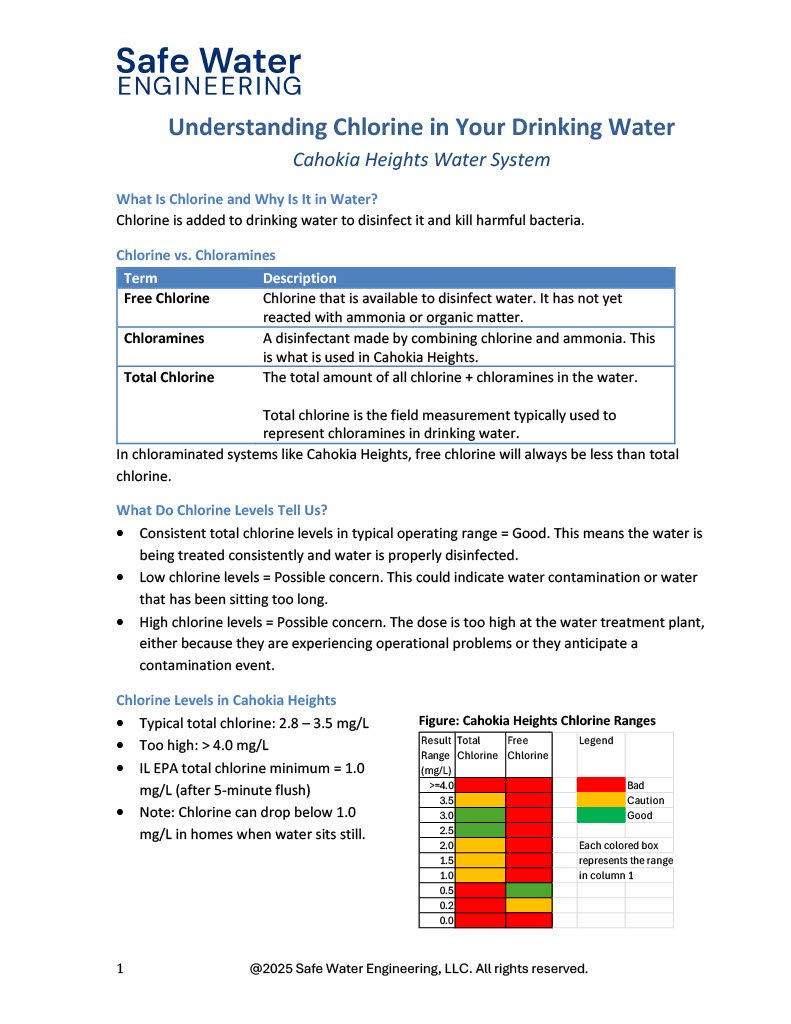
The program also evaluated chlorine residual levels, which help prevent microbial growth as water travels through distribution pipes. Illinois requires total chlorine levels of at least 1.0 mg/L throughout the distribution system to maintain adequate disinfection. Testing found that many households had chlorine levels below this threshold, suggesting that disinfectant levels may not consistently be maintained
Under the U.S. Environmental Protection Agency’s Revised Total Coliform Rule framework, the results observed during the sampling period would have triggered regulatory responses, including a Level 1 Assessment in June and a Level 2 Assessment in July—investigations designed to identify and correct the causes of contamination within a water system. Under federal drinking water regulations, these repeated detections would warrant a systemic investigation of system integrity and disinfection practices [by the state] were this testing conducted by the utilities.
The testing program relied on the participation of resident volunteers who were trained and participated in collecting community samples from their kitchen sinks, along with support for regulatory sampling from trained volunteers through the Sierra Club Water Sentinels program and the East St. Louis Chapter of the NAACP. Sampling protocols mirrored the U.S. EPA Revised Total Coliform Rule, and the program received technical guidance from drinking water expert Elin Betanzo of Safe Water Engineering.
Most of the households tested are serviced by Illinois American Water, with Cahokia Heights providing water to the rest. Residents pay three combined water, sewer, and treatment bills for water that is unsafe to drink, bathe in, or feed to pets. It is imperative both IAW and Cahokia Heights take responsibility for this issue and provide the community with proper warnings, communication, and access to safe and affordable drinking water.
Equity Legal Services is calling for the findings to be reviewed by all appropriate regulatory agencies including the Illinois Environmental Protection Agency and for further investigation into the causes of contamination and low disinfectant levels. ELS implores Illinois American Water and Cahokia Heights to issue an ongoing boil water order until the contamination can be identified and corrected. In the meantime, residents should be provided access to safe water with bottled water provided by these two entities, or stipends to purchase safe drinking water.
Equity Legal Services will continue working with residents, technical experts, and community partners to expand community-based monitoring and advocate for long-term solutions to ensure safe and reliable drinking water for Cahokia Heights residents. Please see the attached report and results for more information.
Reports & Information:
Cahokia Heights, IL Total Coliform and E. Coli Sampling Data Analysis and Recommendations by safe water engineering, LLC 3/10/26
Deidentified Cahokia Heights Sampling Results June_December 2025
Press Releases & Media:
March 9, 2026 Equity legal services “Community-Led Drinking Water Testing in Cahokia Heights Reveals Ongoing Water Quality Concerns”
Frequently Asked Questions (FAQs)
Why community testing?
This program was born out of community concern about safe drinking water. The only reason the program is happening is because residents requested information on their water. Many residents throughout Cahokia Heights report not drinking their water for years due to smell, water coming out brown and black, and household members becoming ill from the drinking water. So, it was imperative the community actively participate in this program by having a chance to test theirs and their neighbors homes.
Oftentimes, when “community” is paired with science, the interpretation is that the science is not as legitimate.
What is your program testing for?
ELS’s testing program was created in conjunction with drinking water expert Elin Betanzo of Safe Water Engineering, LLC, and members of ELS’s science team which includes scientists from Washington University, Williams College, and University of Southern Maine. The program mimics Safe Drinking Water Act requirements for distribution system microbial water quality and disinfectant residual. Our program tests for Total Coliforms, including E. Coli and chlorine levels in residential tap water.
How were the testing protocols developed? What do they include?
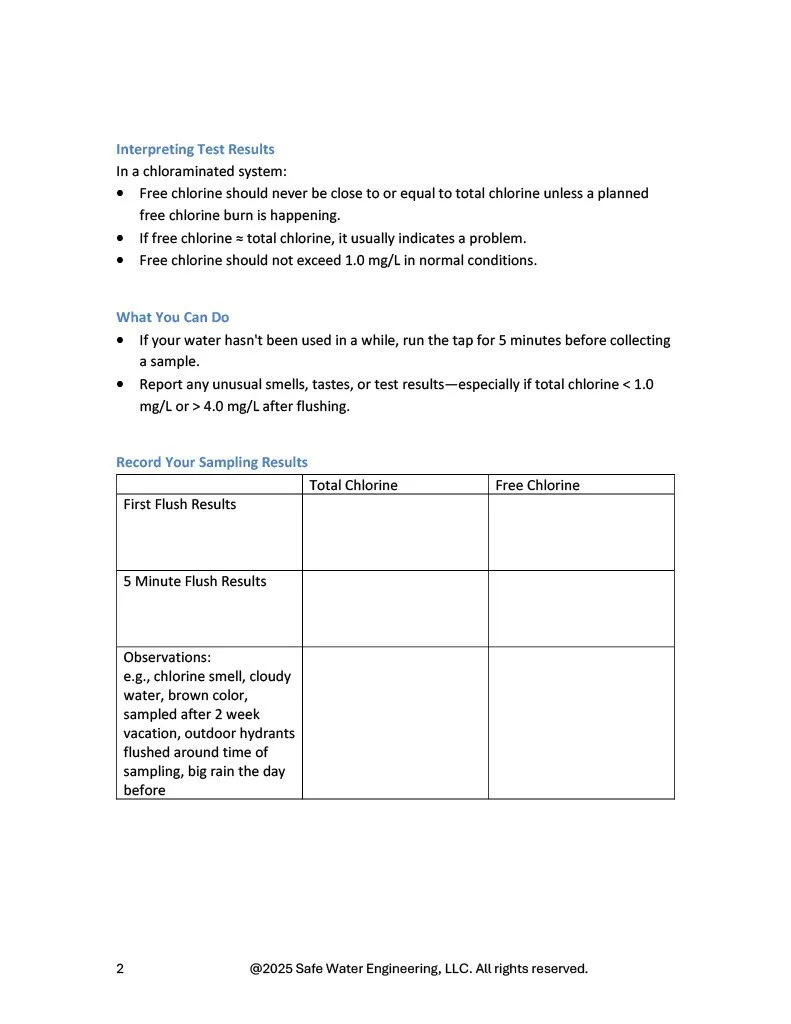
ELS’s testing program was created in conjunction with scientists from Williams College and Washington University, as well as drinking water expert Elin Betanzo of Safe Water Engineering, LLC. The program directly mimics Safe Drinking Water Act requirements for distribution system microbial water quality and disinfectant residual. The testing protocols are based on EPA guidelines and follow the Revised Total Coliform Rule and recognized Chlorine testing procedures used by water utilities throughout the Country. The protocols include step-by-step instructions with associated photos, and are provided to each trained tester at each month’s sampling session. Testers record their chlorine results in an electronic form created by our drinking water expert and on results sheets that are left with residents after each round of testing.
On each testing day, testers are provided with a binder of the protocol documents that outline step-by-step testing processes with photos as well as all supplies needed for testing.
What are Total Coliforms?
Total Coliforms are a broad group of bacteria commonly found in the environment, used as a general water quality indicator. E. Coli is a type of Total Coliform that comes from fecal contamination.
What are chloramines, and why do they matter?
Chloramine is a disinfectant created by combining chlorine and ammonia, commonly used by water utilities to disinfect tap water. Chloramines, which are measured during testing as “Total Chlorine,” are measured to confirm that the system is maintaining enough disinfectant to control microbial growth. In Illinois, chloramine levels must be at least 1 mg/L throughout the distribution system, or the system becomes susceptible to contamination.
Can you explain the inconsistencies between your Teklab and community testing results?
Both the Teklab and community samples were collected following the testing protocol that directly mimics the Revised Total Coliform Rule. Tests were collected immediately, one after the other, and then stored in their respective coolers to be transferred to the certified lab and the ELS offices for analysis. Community tests were completed at ELS following the Colilert testing procedures. Teklab tests were delivered to Teklab and processed in-house. ELS cannot speak to Teklab’s internal procedures, but Teklab was chosen because they are certified by the Illinois Department of Health for microbiological testing using the Colilert-18 method. The Cahokia Heights Water Department uses Teklab to analyze their RTCR samples.
No matter which data set you look at, contamination is present 6 out of the 7 months. Looking at either data set, Teklab or Community – a Level 1 assessment of the system would have been triggered for all months except November, and a Level 2 assessment would have been triggered by July.
IAW says that their water is safe when it leaves their plant, and they cannot control what happens to it on the way to residents' homes. What is ELS’s response?
IAW is responsible for delivering clean, safe drinking water through its treatment plant and water mains. But no one drinks water from the plant or from the water main in the street. Safe water is only meaningful if it reaches residents’ taps, safe to drink. If water leaves the plant meeting standards but does not arrive safely inside homes, residents are still exposed. Compliance on paper does not protect people if the water at the tap is contaminated.
If residents are alerting IAW that their water is not safe, as an agency responsible for protecting public health and delivering safe water, it is IAW’s responsibility to investigate, identify, and resolve the issue. If IAW is alerted that water is testing positive for contamination, it is irresponsible to not investigate or alert the community to ensure neighboring residents are staying safe. Safe drinking water should be a right and not a privilege saved for more wealthy white communities.
Persistent total coliform positives at distinct locations demand investigation. Using them as a rationale for inaction in a regulated water system is unconscionable.
The City of Cahokia Heights responded to the community water testing results, suggesting that residents with positive E. coli results have a problem at their home, possibly because of the age of their home. What is ELS’s response?
“The City of Cahokia Heights, formerly Centreville, has had failing infrastructure for many years. In fact, in August 2021, Cahokia Heights was placed under an administrative order by the USEPA because of the conditions of its drinking water utilities. Records show the City has consistently mismanaged their systems that residents rely on for access to basic needs —- including the sanitary sewer system —- dating back to at least the 1990s.
This is no different. The City cannot have it both ways — proclaim the contamination is due to the age of residents’ homes yet, declare in the same breath that they are seeking funding to replace pipes.
To be clear, multiple homes throughout the City of Cahokia Heights tested positive for E. Coli and fecal coliform over the span of 7 months. This is no coincidence. Nor are the swaths of residents who have tested positive for H. pylori per their respective physicians. Notably, H. pylori is often found in areas with poor sanitation systems and can be spread through drinking water that is contaminated. Additionally, the ongoing Washington University study of residents in Cahokia Heights shows this community nearly doubles the national average of individuals diagnosed with H. pylori.
This isn’t about the age of homes or any other red herring the city uses to deflect from its responsibilities. Drinking water, stormwater flooding, and sewage overflows have been issues for decades with City leaders at the helm.
The City has a fundamental obligation to deliver services that are safe, operational, and reliable — services residents fund through their taxes. Its track record in meeting that obligation has been, at best, abysmal. Accordingly, we suggest the City direct its attention toward delivering the services residents depend on and addressing the public health risks that have emerged in connection with its poorly managed systems.”
If you are a resident of Cahokia Heights or East St. Louis, Illinois and are interested in having your water tested in future testing cycles or would like to complete a survey on your drinking water quality, please click the links below.